The Summer Kitchen: This add-on extension - though not mandatory on Georgian homes - was often found attached to the main house, on many Canadian homes during the 19th century. It is easy to see why.
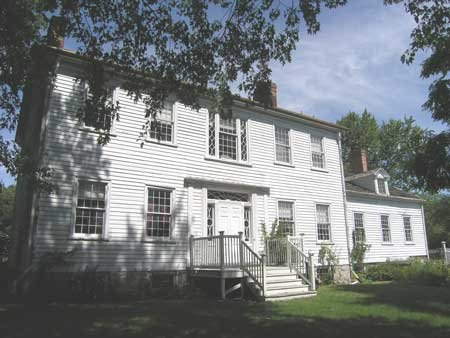
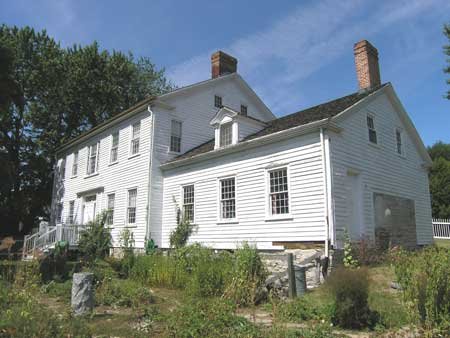
Left is the southern, front view of the house, facing the river, and showing the summer kitchen addition.
In the days when cooking and baking went on all day long, especially in big households, fires were burning constantly in the fireplace, generating a lot of heat.
In the winter this was no problem. Kitchen heat produced from cooking would be additional heat to warm the house. So winter kitchens were often placed in the basement, underneath the chief living quarters on the main floor.
Left is the winter kitchen with the fireplace chimney on the outside wall of the basement, of the far, west side of the house. On the main floor, immediately above, are the parlor, and on the right, the central hall of the house.
With the coming of summer, the cooking heat produced in the basement made the room temperatures upstairs unbearable. So the summer kitchen addition was built at the eastern, opposite, end of the house.
This way the heat could be more isolated from the main living quarters in the summer months. These would often be added years after the main house was erected and the homestead more established. More than a few had a bell on the roof line to call workers from the distant fields in for supper.
Below is the layout of the summer kitchen, with the fireplace against the near, east wall of the kitchen clearly visible below the chimney.
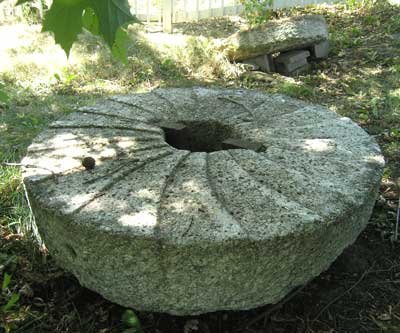
The mill wheels, that once ground the grain for the household, now lie forlorn and forgotten in a corner of the lot
above and
left.
Until commercial mills started to operate, using even larger mill wheels, farmers used small ones to mill their own grain into flower to make bread, and biscuits. In remote homesteads domestic milling went on much longer, making use of smaller millstones, which a woman could often turn by hand.
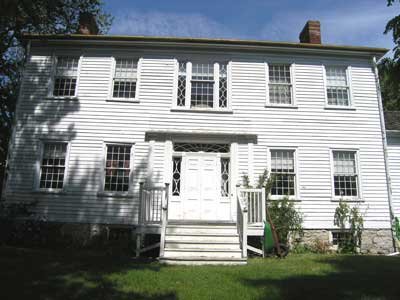
The mathematical regularity and symmetry of the five bay Georgian facade can be clearly seen here.
The winter kitchen is below the two lower left windows and the hallway door. The two windows are for the parlour; the two above for the "John A Macdonald ballroom."
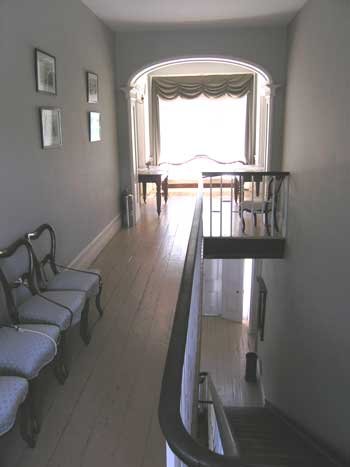
The large palladian window is to illuminate the upper hall. The two lower windows on the right are for the receiving room, another "public" room in the house.
The upper right two windows are for the Macpherson's master bedroom. Mrs. Macpherson's secret passage runs down at an angle towards the summer kitchen lower right. It too has a passage that runs under the house all the way through the cellar to the winter kitchen at the extreme left .
The heating of all the rooms of the house can be clearly seen; fireplaces are at the extreme ends of the house serviced by a single chimney at each end of the roof line.
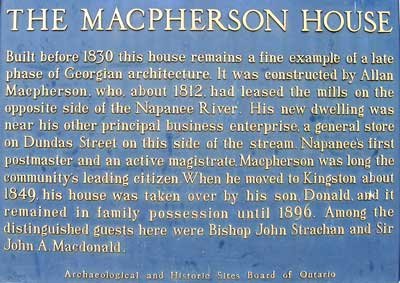
In Canada the Georgian style of building dominated the first half of the 19th century, much favoured by well-to-do refugees from the United States who used it to show their continuing loyalty to Britain.
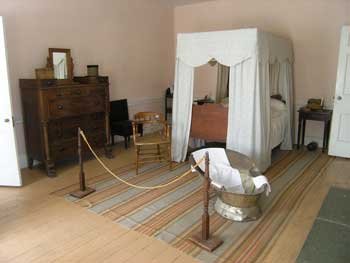

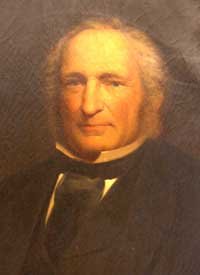
The woman who dominated the household was Mrs. Macpherson, who looked like she was up to the job. She had 12 children so she was pregnant and in seclusion in her room right, much of the time.
But she was also the boss of the kitchen and the baking and so made use of a secret passageway that connected this room, through the door right, to the summer kitchen at the back of the house, and then through the basement to the winter kitchen, so she could avoid needless public exposure of "her condition" to the constant flow of visitors to this important stopping place in early Napanee.
|
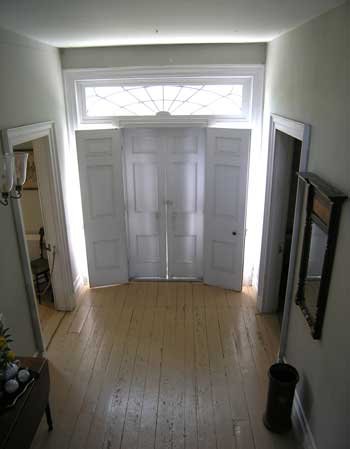 |
| Above, the classic centre hall and stairway that split the Georgian house in two, giving access to all the rooms of the house, left and right, off the centre hall.
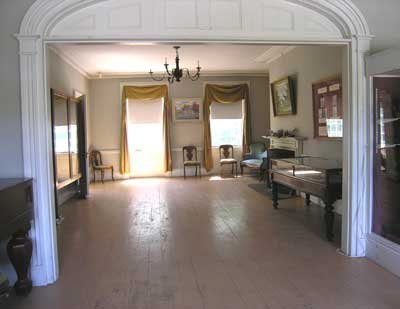
Below the ball room on the second floor situated to the right of the top of the stairs above. Sir John A Macdonald, Canada's first Prime Minister, and hailing from nearby Kingston, Ontario, often visited the house and this room. He was a bit of a playwright and often acted in plays staged in this room in front of local audiences. |
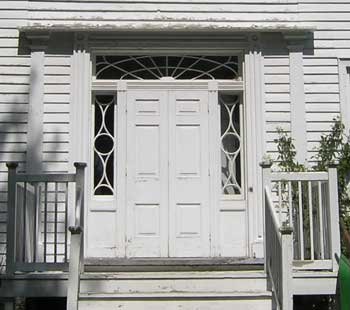
The centre hall design permitted both a front and rear door at the centre of the house. Above, is the main door facing south.
Georgian doorways were massive and looked unique. To give light to the centre of the house, typical Georgian features included transom lights, over, and side lights, to the left and right of the doorway, as seen on the front door, inside and out, above and below. |
 |
 |
|




 Great Canadian Heritage Treasure