


 Great Canadian Heritage Treasure Great Canadian Heritage Treasure |
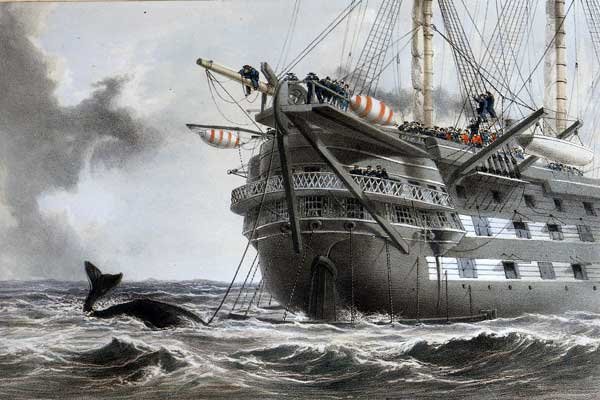
Here a whale fouls the attempt by HMS Agamemnon to lay an early cable in 1858. The attempt was called off, and the Great Eastern later engaged to do the work. |
 |
|
| Lithograph, HMS Agamemnon Laying the Atlantic Telegraph Cable in 1858; A whale Crosses the Line | |
| Orig. lithograph - Image Size -15 x 22 cm Found - Napanee, ON "The Atlantic Telegraph" - Artist - Robert Dudley, Auth - WH Russell; Pub - Day & Son Ltd. London, 1865 |
| Great Canadian Heritage Treasure |
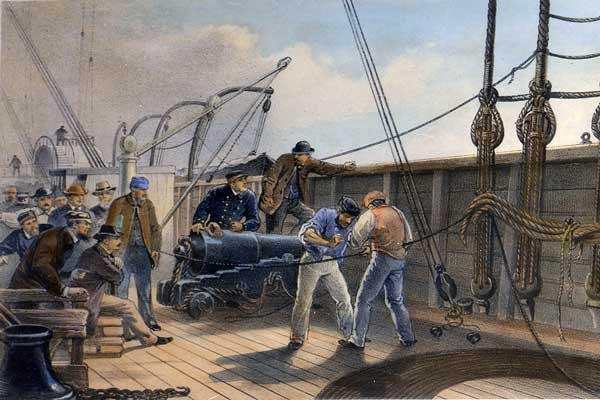
A lot of the examination of the cable was done visually, usually with more people looking on, than looking at problems on the cable. |
 |
|
| Lithograph, Splicing the Cable After the First Accident On Board the Great Eastern July 25th | |
| Orig. lithograph - Image Size -15 x 22 cm Found - Napanee, ON "The Atlantic Telegraph" - Artist - Robert Dudley, Auth - WH Russell; Pub - Day & Son Ltd. London, 1865 |
| theCanadaSite.com |
| Copyright Goldi Productions Ltd. - 2009 |
| Great Canadian Heritage Treasure |

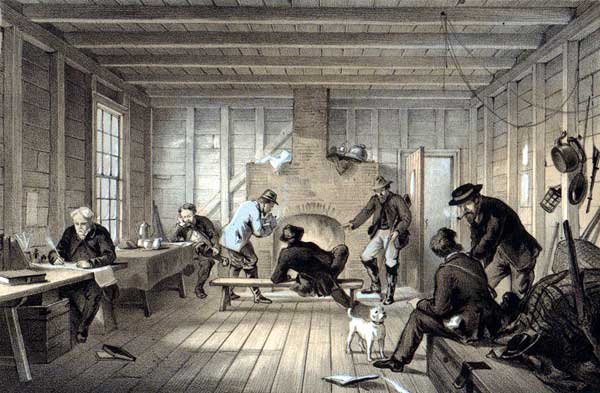
The men inside are lolling about in the mess. The cable station is a museum now but you can still see the rusting lengths of cable emerging from the ground at the water's edge and and see the exact spot where this historic event happened. |
 |
|
| Lithograph, Trinity Bay, Newfoundland Telegraph House, 1857-58, Interior | |
| Orig. lithograph - Image Size -15 x 22 cm Found - New York, NY "The Atlantic Telegraph" - Artist - Robert Dudley, Auth - WH Russell; Pub - Day & Son Ltd. London, 1865 |
| Great Canadian Heritage Treasure |
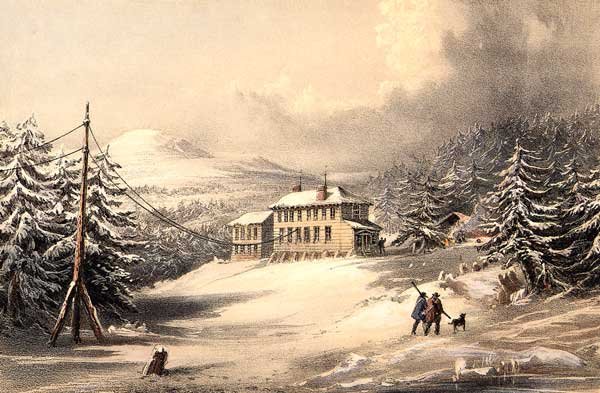
It had taken a year from July 1865 to July 1866 to bring the cable to Newfoundland.
Robert Dudley has wonderfully captured the cold and desolate country that Canada was in the 1860s. The ship actually parked inside the bay at Heart's Content, Newfoundland, which has little changed since the momentous day in July 1866 when the sailors struggled ashore with the great Atlantic cable.
|
 |
|
| Lithograph, Trinity Bay, Newfoundland Telegraph House, 1857-58 | |
| Orig. lithograph - Image Size -15 x 22 cm Found - New York, NY "The Atlantic Telegraph" - Artist - Robert Dudley, Auth - WH Russell; Pub - Day & Son Ltd. London, 1865 |
| Great Canadian Heritage Treasure |
Cable laying did not stop at night. Paying out cable was a slow process and took many men: some to bring it up from below, others to pay it through the machinery, and more to do the repairs of cable and machines that were required for this operation.
It's amazing that anyone got any sleep. It was an exciting time, not only historically, but also meteorologically Passenger liners and sailing ships could dash across the Atlantic Ocean and escape bad weather and storms. Not the Great Eastern; she was permanently tethered to her cable and had to take, without complaint, the worst that mother nature could lay on. |
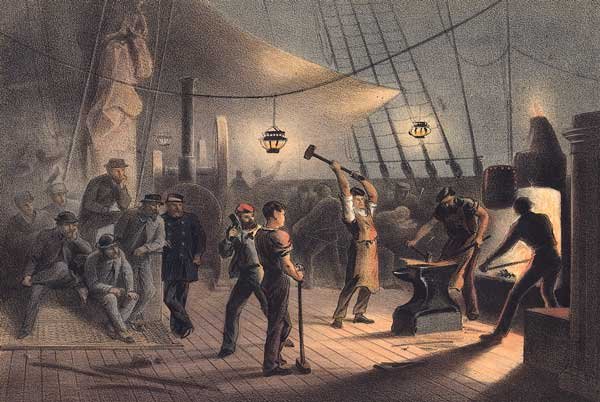 |
|
| Lithograph, The Forge on Deck, Night of Aug. 9, 1865 | |
| Orig. lithograph - Image Size -15 x 22 cm Found - New York, NY "The Atlantic Telegraph" - Artist - Robert Dudley, Auth - WH Russell; Pub - Day & Son Ltd. London, 1865 |
| Great Canadian Heritage Treasure |
The cable, and the buoy, would finally be raised to the deck and the many gouges and tears that the grappling hook had made, to the covering of the cable, repaired. The ship's cable end would be spliced on, and a message sent back to Ireland to test the success of the repair, and the strength of the signal. The cable laying could begin again. |
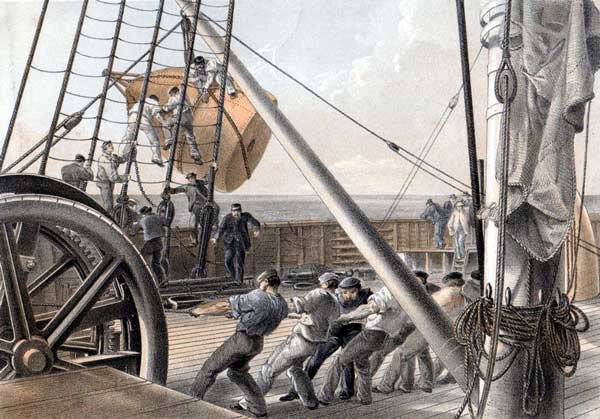 |
|
| Lithograph, Getting Out One of the Large Buoys for Launching, Aug 2 | |
| Orig. lithograph - Image Size -15 x 22 cm Found - New York, NY "The Atlantic Telegraph" - Artist - Robert Dudley, Auth - WH Russell; Pub - Day & Son Ltd. London, 1865 |
| Great Canadian Heritage Treasure |
The steam operated winch and the sail still in evidence and still necessary on this great iron steamship. |
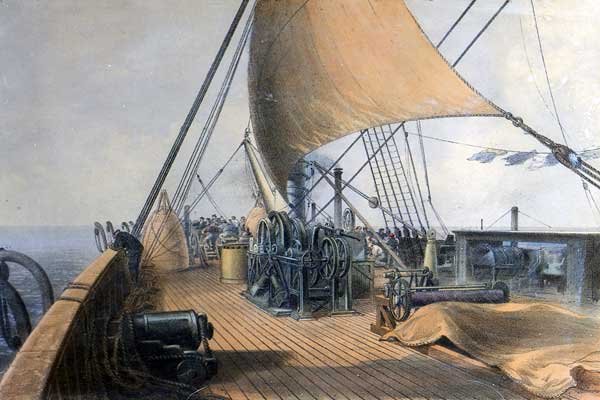 |
|
| Lithograph, Forward Deck for the Final Attempt at Grappling, Aug 11th | |
| Orig. lithograph - Image Size -15 x 22 cm Found - New York, NY "The Atlantic Telegraph" - Artist - Robert Dudley, Auth - WH Russell; Pub - Day & Son Ltd. London, 1865 |
| Great Canadian Heritage Treasure |
The grappling hook is shown hanging from its forward pulley. It has been dragged across miles of ocean trying to locate the broken cable. Finally, success! And now to mark the spot on the surface! As the location marker buoy is lowered, one gets an idea of the immense size of the ship. The men are mere ants in the rigging, and along the deck, and totally dwarfed by the size of the anchors that the Great Eastern carries.
|
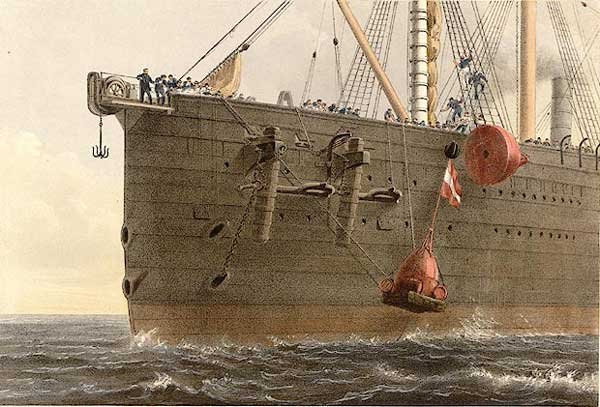 |
|
| Lithograph, Marking the Spot Where the Cable Had Been Grappled, Aug. 8, 1865 | |
| Orig. lithograph - Image Size -15 x 22 cm Found - Toronto, ON "The Atlantic Telegraph" - Artist - Robert Dudley, Auth - WH Russell; Pub - Day & Son Ltd. London, 1865 |
| Great Canadian Heritage Treasure |
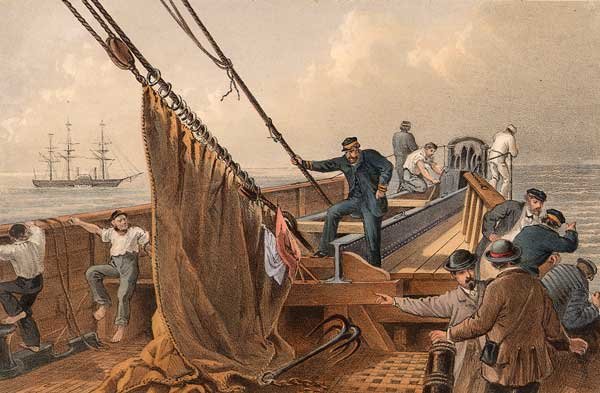
Sometimes, like on August 2, left, the cable was lost altogether, breaking off because of rough weather, or machinery failure.
Then the grappling hook, lying on the foredeck left had to be brought out, and the foredeck area cleared for the grappling operation off the bow. The ship would steam back and forth trying to hook the fallen cable on the ocean bottom. It might take days before it would be found again. Then it might slip off again as they were trying to bring it to the surface. Then the grappling would begin again. Many days were spent in these salvage operations. |
 |
|
| Lithograph, In the Bows, the Cable Broken and Lost, Preparing to Grapple, Aug. 2, 1865 | |
| Orig. lithograph - Image Size -15 x 22 cm Found - Napanee, ON "The Atlantic Telegraph" - Artist - Robert Dudley, Auth - WH Russell; Pub - Day & Son Ltd. London, 1865 |
| Great Canadian Heritage Treasure |
|
 |
|
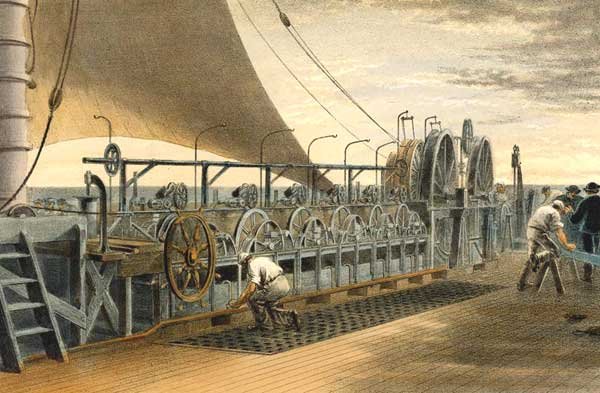
| Lithograph, The Paying Out Machinery | |
| Orig. lithograph - Image Size -15 x 22 cm Found - Napanee, ON "The Atlantic Telegraph" - Artist - Robert Dudley, Auth - WH Russell; Pub - Day & Son Ltd. London, 1865 |
| Great Canadian Heritage Treasure |
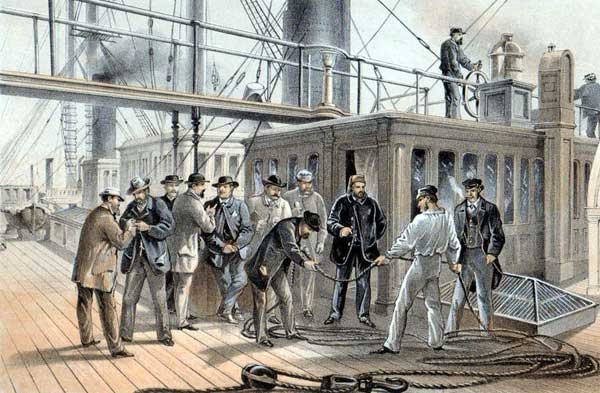
To make sure that the cable was in top condition before it went over the side, it was inspected visually, as well as electrically, with messages sent back to Ireland constantly to make sure the signal remained strong. When it grew weak, or failed altogether, the cable had to be hauled back in, and minutely examined, until the fault was found and corrected. |
 |
|
| Lithograph, Searching for Fault After Recovery of the Cable from Bed of the Atlantic, July 31 | |
| Orig. lithograph - Image Size -15 x 22 cm Found - New York, NY "The Atlantic Telegraph" - Artist - Robert Dudley, Auth - WH Russell; Pub - Day & Son Ltd. London, 1865 |
| Great Canadian Heritage Treasure |
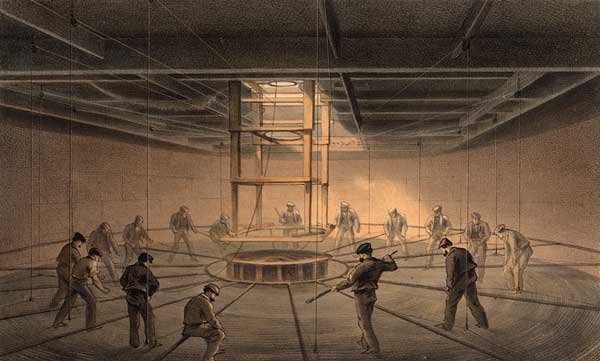
The extensive handling this cable endured made it susceptible to damaging gouges, not so much to the copper core, but to the Gutta-percha insulating covering. To make sure that the cable was in top condition before it went over the side, it was inspected visually, as well as electrically, with messages sent back to Ireland constantly to make sure the signal remained strong. When it grew weak, or failed altogether, the cable had to be hauled back in, and minutely examined, until the fault was found and corrected. |
 |
|
| Lithograph, Interior of One of the Tanks Aboard the Great Easter, Paying Out Cable | |
| Orig. lithograph - Image Size -15 x 22 cm Found - Toronto, ON "The Atlantic Telegraph" - Artist - Robert Dudley, Auth - WH Russell; Pub - Day & Son Ltd. London, 1865 |
| Great Canadian Heritage Treasure |
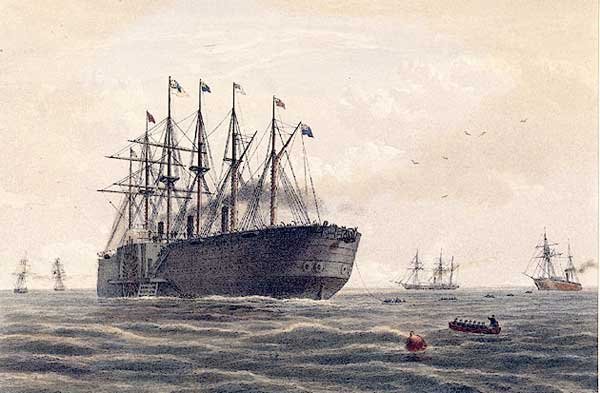
Actually no, she steamed, driven by paddle wheels and a screw propeller, neither of which were strong enough, on their own, to drive the ship efficiently. Once at sea the onerous task of laying the cable began, paying it out from the various tanks below decks left and over the side. The extensive handling this cable endured made it susceptible to damaging gouges, not so much to the copper core, but to the Gutta-percha insulating covering. |
 |
|
| Lithograph, The Great Eastern Under Weigh July 23 | |
| Orig. lithograph - Image Size -15 x 22 cm Found - New York, NY "The Atlantic Telegraph" - Artist - Robert Dudley, Auth - WH Russell; Pub - Day & Son Ltd. London, 1865 |
| Great Canadian Heritage Treasure |
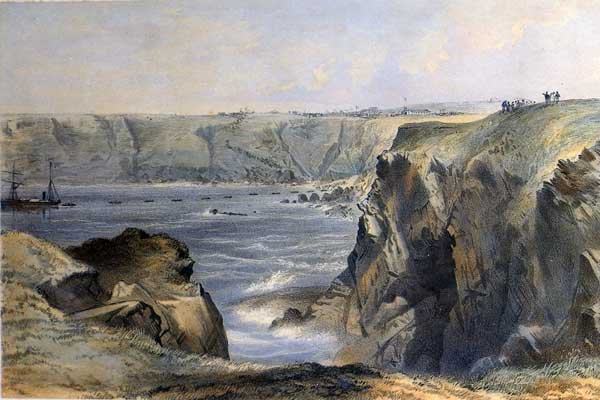
There was already a cable connection between Ireland and England so the cable laying started from a remote bay on the west coast of Ireland. |
 |
|
| Lithograph, Foilhummerum Bay from at Valencia; the Caroline and Boats Laying the Earth Wire Jul 21 | |
| Orig. lithograph - Image Size -15 x 22 cm Found - Napanee, ON "The Atlantic Telegraph" - Artist - Robert Dudley, Auth - WH Russell; Pub - Day & Son Ltd. London, 1865 |
| Great Canadian Heritage Treasure |
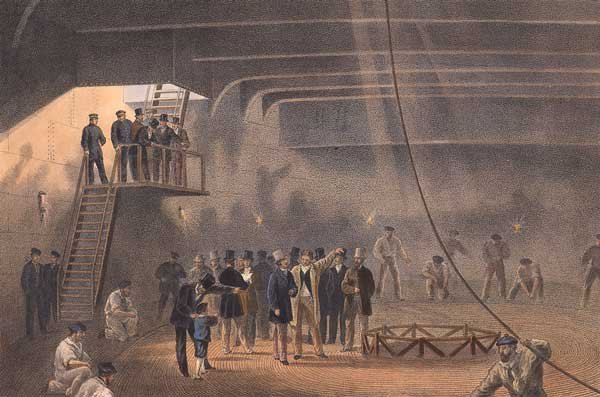
Arthur Clarke called the laying of the Atlantic cable the nineteenth century's equivalent to the Apollo Moon Project. No wonder the Prince of Wales himself came to see the activities. Left, Prince Albert Edward - who had visited Canada only five years before - visits the Great Iron Ship as it is taking on hundreds of miles of cable. The heavy cable is being let down from the upper deck and manhandled into giant coils in one of the giant tanks, or rooms, built to hold the cable. The size of the operation can be judged when one remembers that the men are actually standing on the coiled cable as a man in the foreground walks it around the outside of the expanding coil. |
 |
|
| Lithograph, Coiling the Cable in the After Tank; Visit of HRH the Prince of Wales, May 24, 2025 | |
| Orig. lithograph - Image Size -15 x 22 cm Found - Toronto, ON "The Atlantic Telegraph" - Artist - Robert Dudley, Auth - WH Russell; Pub - Day & Son Ltd. London, 1865 |
| Great Canadian Heritage Treasure |
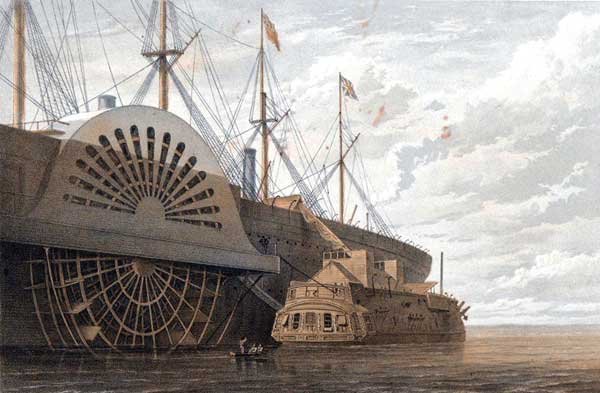
The hulk, which looked big enough in the earlier litho, is dwarfed by the immense size of the ship itself and the huge paddle wheel housing. Visible too are, Wednesday, Thursday, Friday, and Saturday, the aft four masts of the great ship. |
 |
|
| Lithograph, Loading the Cable from the Hulk | |
| Orig. lithograph - Image Size -15 x 22 cm Found - New York, NY "The Atlantic Telegraph" - Artist - Robert Dudley, Auth - WH Russell; Pub - Day & Son Ltd. London, 1865 |
| Great Canadian Heritage Treasure |
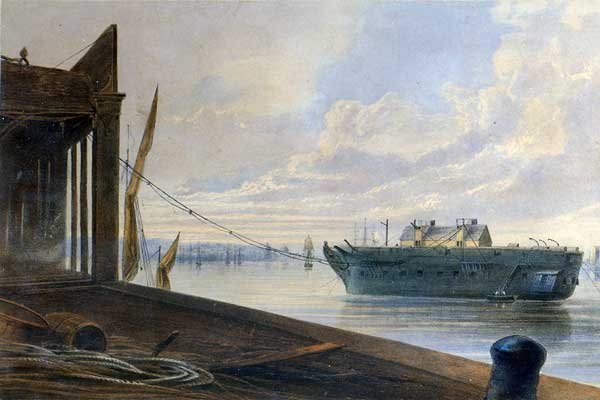
The Great Eastern herself was too huge to come into the shallows near the factory. So the cable was first put on an intermediate transport barge - a dismasted old sailing ship - that was parked nearby. |
 |
|
| Lithograph, The Cable Passed from the Works Into the Hulk Lying in the Thames at Greenwich | |
| Orig. lithograph - Image Size -15 x 22 cm Found - Napanee, ON "The Atlantic Telegraph" - Artist - Robert Dudley, Auth - WH Russell; Pub - Day & Son Ltd. London, 1865 |
| Great Canadian Heritage Treasure |
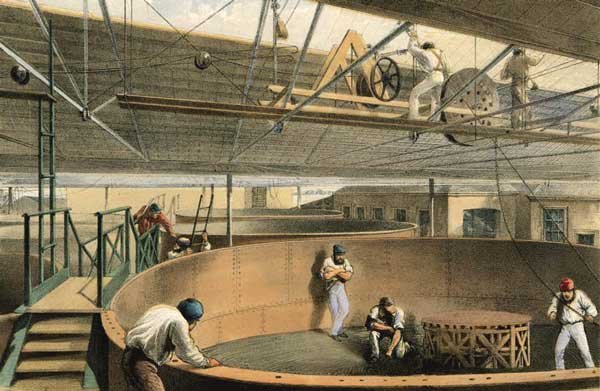
Left, the finished cable, coated with Gutta-percha is being coiled inside huge tanks at the factory.
The man on the right walks the cable in a circle, with the coils gradually filling the tank to the top. After he gets tired, two more coilers, who are resting after their exertions, will take over in turn. |
 |
|
| Lithograph, Coiling the Cable in the Large Tanks at the Works, in Greenwich | |
| Orig. lithograph - Image Size -15 x 22 cm Found - Toronto, ON "The Atlantic Telegraph" - Artist - Robert Dudley, Auth - WH Russell; Pub - Day & Son Ltd. London, 1865 |
| Great Canadian Heritage Treasure |
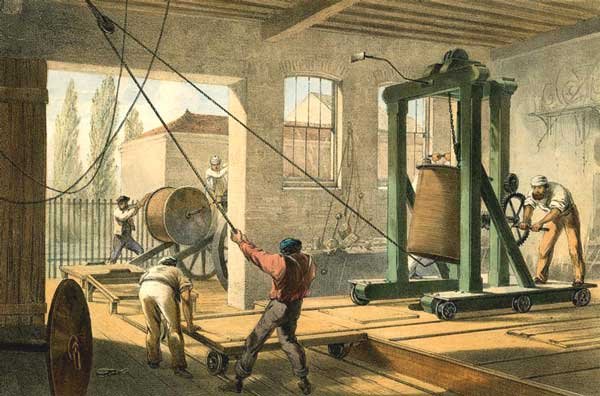
The copper cable was manufactured at Greenwich, and insulated from abrasion and water by being covered with a newfangled plastic called Gutta-percha, which is shown arriving at the works left. Hundreds of miles of cable were needed. It was stored on site in huge tanks. |
 |
|
| Lithograph, Reels of Gutta-percha Conduction Wire Arriving at the Works | |
| Orig. lithograph - Image Size -15 x 22 cm Found - Toronto, ON "The Atlantic Telegraph" - Artist - Robert Dudley, Auth - WH Russell; Pub - Day & Son Ltd. London, 1865 |
 |
Robert Dudley, WH Russell, Day & Son Lithos - 1865 |