The Allies had to act fast...
And Norm Pearson came home and put away his bugle
 Postscript: Norm Pearson moved to the United States in May 1919 where he spent the rest of his life. He passed on in 1978.
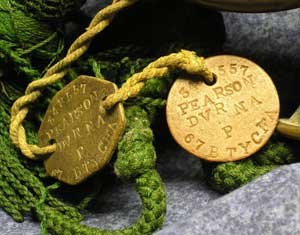
Norm's bugle, dog tags, and photograph came to the Canadian Anglo-Boer Museum courtesy of his son, Leon Pearson of Asheville, NC, in the US.
 Great Canadian Heritage Treasure Great Canadian Heritage Treasure |
An absolutely marvelous Great Canadian discovery, illuminating a part of Canadian history few people know anything about - Canadians in Russia in 1918, including Norm Pearson of the 67th Battery of the Canadian Field Artillery. These dog tags and bugle experienced it all...
In June 1918 500 Canadian artillerymen of the 67th and 68th Batteries, Canadian Field Artillery, were sent to occupy the northern Russian ports of Murmansk and Archangel. Canadians were especially selected for the cold northern regions of Russia because of Canada's reputation as a country of hardy people from a harsh country with a cold arctic climate. |
 |
|
| Norman Arthur Pearson's bugle, 1917 | |
| Henry Potter - Size - 11.5" Found - Asheville, NC Signed Henry Potter 1916 , copper & brass with original patina, bugle cords, and dog tags, to Norman Pearson 67th Battery CFA |
|
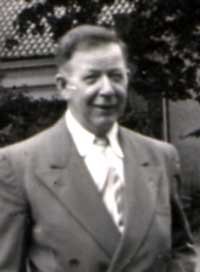 Norman A. Pearson, (CFA) Canadian Field Artillery: Norman A. Pearson, (CFA) Canadian Field Artillery:
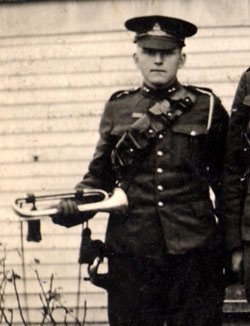
Norman Arthur Pearson was born in Kingston, Ontario, on Nov. 10, 1898, right in the middle of the Spanish American War hubbub. Then the Boer War followed for three more years. (Left, Norm in 1956)
In 1914, when World War I broke out, at the age of 16, he lied to get into the army. He became a bugler in the 67th Battery of the Canadian Field Artillery which was sent to fight in Russia in 1918. (below the 68th CFA, in 1918, a sister battery which also went along to Russia). After the war he and his wife moved to Rochester, New York. He was employed in the early automobile manufacturing industry. He worked for years as a machinist at the Gleason Mfg. Company, the only company in the world making beveled gears. It refused to sell them to Nazi Germany, so Hitler had to make his own.
Left and right, the buglers of the 68th, whom Norm got to know quite well during their Russian adventures. They hold the "camp trumpet" in their hands. Slung by a long khaki cord across their chests, is the regular bugle - a Henry Potter similar to Norm's above - hanging below the waist at the side. Norm preferred slinging his bugle short, from the same shoulder of the side the bugle hangs.
|
|
 Canadians in Russia: The Allies decided to send troops to different parts of Russia to reopen the Eastern Front. As part of this effort, Canada sent troops to Russia.
 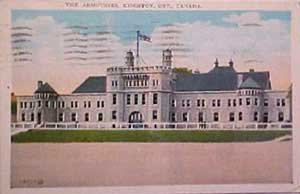 So he grew up hearing "thrilling tales of action." It must have whetted his appetite for "adventure" as he hung around the Kingston armouries (right as it looked to Norm) listening to stories from the war.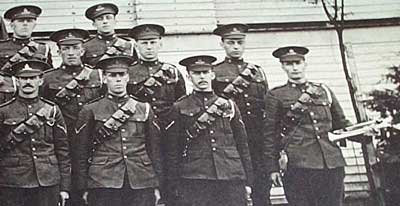
 After he retired Norm became a teacher with Manpower & Youth Development, teaching his beloved machinist trade to younger students, which he did with great satisfaction till the end of his life.
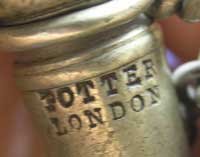
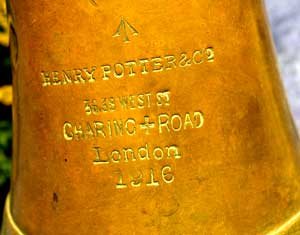 Norm's bugle is a Henry Potter, which is stamped on both the bugle above the bell and on the mouthpiece. Potter made thousands of bugles for the Victorian British Armies as they fought in Africa, India, the Sudan, Ethiopia, and during World War 1.
  Norm's original khaki bugle cords are still wrapped tightly around the bugle as he left them, when he bundled them up with his dog tags, and put them away forever, so many years ago.
| Great Canadian Heritage Treasure |
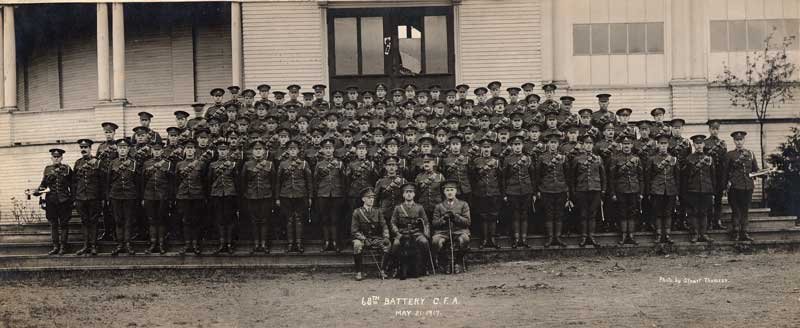 |
| The 68th Battery, Canadian Field Artillery, before leaving for Russia to fight the Bolsheviks, 1917 |
| Orig. photo - Size - 7" x 16.5" Found - Vancouver, BC Photo by Stuart Thomson, Vancouver , May 21, 2025 |
| theCanadaSite.com |
| Copyright Goldi Productions Ltd. - 1996, 1999, 2005 |


